Passion & self-confidence are almost necessary for leading when you're not in charge. It's definitely necessary to work on these things if you don't have them already and you're trying to lead from a position of 'not in charge'.
The idea that 'if you're not passionate then you're wasting your time' is quite negative if you think it means: 'if you've not got a passion for what you do then just give up'. If you make this positive and realise that it means 'if you've not got a passion for what you do then search for a small amount and cling onto that to drive you further'. It's about choosing to look for passion where it's been lost. This is no mean feat. I'm currently in a position of serving someone else's vision and it's hard. In fact, it's almost impossible when you've got visions of your own that cannot be brought in to the equation. But I have to begin to own some of the passion that does match up. Ultimately, I have a passion for people finding Jesus and knowing Him, I have a passion for children being free to express the whole whack of Holy Spirit that's inside of them, and I have a passion to see the youth of my hometown come together as one body. The first two of these things I am able to witness and serve in my position. The last passion is a work in progress that I find easier to pursue in other local churches with larger youth groups.
Self-confidence is a b i g thing. I've grown up my entire life thinking that I've been dealt a pretty good amount of self-confidence. Last night, my perceptions changed. It's something I'm working on. The reason I'm telling you this is not to give you less confidence in me, but to acknowledge that everyone struggles with lacking in some areas of self-confidence. "Self-confidence is the first requisite to great undertakings" can put pressure on ourselves to feel the need to be perfectly happy with who we are. I think self-confidence needs to come down to recognising what things you don't like about what you do and how you think and knowing that these things are not who God made you to be. You were not made to be anxious. You were not made to project your feelings. You were not made to lack in compassion. You were made perfect and God wants to work in and through you despite your imperfections. That's the self-confidence that is needed. A self-confidence that has little confidence in who you are but 100% confidence in who God made you to be and in God Himself.
The influencers lead!
1. Lead yourself.
Learning to lead is learning to be a good follower.
A star follower says: "I want to help you achieve what you want to achieve".
Proving that you can lead yourself, arguably gives you more opportunities to lead others. If you can lead yourself, you will be top of the list when the organisation look to promote someone into a position of "higher" leadership.
2. Choose positivity.
Make it a choice.
The greatest thing you can bring to your team is the positive emotional energy.
Keep moving forward.
Think 'we' over 'me'.
More important than making the right decision is taking the decision and making it right. You can undermine the momentum around the decisions of an organisation, but you can also propel it! Get 100% behind it and make it work.
Here's a story from Andy Stanley's church...
The church had expanded to the point where they needed a West and an East auditorium for the service. This meant a congregational split. Those sat in the East would get the live sermon, those sat in the West would get a live feed of the sermon on a big screen.
It had been decided that people with surnames A-M would sit in the East and those with surnames N-Z would sit in the West.
A girl, who was explaining the new system to a guy who had missed the meeting, saw his distaste and she said 'oh really, I thought it was a great idea!'. This took him aback and he began to think that he'd missed something and it would be a good idea after all. Then she began to snicker, and she broke and said 'Andy told us to tell anyone who thought it wasn't a good idea that we thought it was a great idea!' The positivity made it a great idea. If she had gone 'I know *whisper* I thought the same thing'. then she would have fed the negative energy surrounding the new idea. The idea was happening whether they liked it or not and she would've just made it a great idea for him.
This idea doesn't quite sit well with me. Which is ironic because I should have positive energy flowing out from me about this new way I need to lead when I'm not in charge. But I'm honestly not so positive about the idea. I'd be more comfortable with saying 'Ah I think it could work! It's not an awful idea after-all and we can see how it goes' because that's what I'm really thinking. Why lie and say that I think it's a great idea when I don't? There's positivity and then there's lacking genuinity (my new made up word for more impact in this sentence).
When we struggle with not being involved in a decision and then having to watch it happen even though we oppose the idea, we can think of choices that we don't get to be involved in as 'that's okay, they are taking that thing off of my plate so I can focus on what I'm doing'.
So there are my jumbled thoughts about some things surrounding leading from a position of not being in charge. I'm going to process this a little bit more today...
I'd love to say that I've returned from Mexico fluent in Spanish but, alas, that just isn't the case. So luckily for you my blog posts will still be in English*. About the only phrases I learnt or used were:
Casa | House
Baño | Toilet
Me gusta | I like
Hola | Hello
Adios | Goodbye
Dios | God
¿dónde está mi piña? | Where is my pineapple?
That last phrase was definitely said the most within our ReBuild team. The story behind it is simple yet hilarious. Emma and myself were on site for kid's club. It was the first kid's club of the week so there were only a few children around before word got out. This meant that to start with we had more than one volunteer per child. So Emma and I stepped back and chatted to a lady from Amor. She taught us how to ask an older lad, who looked about 15, what school year he was in. Emma tried it out loud a few times before approaching the young boy and asking ' ¿dónde está mi piña? '. The confusion on his face scared Emma into asking again, this time she altered the intonation in her question. An even more confused look arose on his face as he realised she actually had asked where her pineapple was the first time. Much to Emma's distress we all found it extremely funny. Emma then learnt how to say sorry and the lady from Amor explained to the boy that she had played a trick on Emma. He laughed along too.
Over the next few days I plan to share some of my stories about my first trip to Mexico, my first ever mission trip, and my first house built by myself and an amazing team in just 30 working hours.
A little story that I've got to share upon returning to the UK is probably different to what you would expect. This afternoon I begun to upload my videos from the trip ready to make a few videos to show my friends and family. As I copied the files across from my SD card to my laptop I got a notification saying something along the lines of 'Your startup disk is nearly full, delete some files.' I stopped the upload of any further files and went downstairs to find my back up hard drive. As I was plugging the lead into my laptop, the entire thing shut down. It had been on 90% battery just a few minutes previously. Much to my disappointment, I couldn't get the computer to turn back on. In the back of my mind I was actually very much at peace with the situation. Still knowing where we'd just come from and how I hadn't missed my laptop at all, I felt all the more detached from the heap of metal I was once inseparable from. After over an hour talking to Keith from Apple, who happened to be extremely nice, I still hadn't seen light from my laptop. Considering I hadn't freaked out earlier now would've been the ideal opportunity, but I didn't. I didn't feel the urge to scream, to cry, to press random buttons harder and harder until something worked. I was level-headed and kept a conscious new perspective in the back of my mind the entire time.
As of yet my laptop is still unusable. I'm writing this from Emma's (thank you to my bestest friend in the whole world forever and forever, I love you) which she has lent to me for the next few days to get the Mexico film editing done.
I'll be taking my laptop into Apple to be seen by an Apple doctor very soon but in the meantime I'm so thankful to God for keeping me calm and showing me the perspective I need since returning to my 'luxury' home after camping in a desert for a week.
Amy xo
*You can now translate my posts to most languages using the translate button on the right hand side of my blog page.
Children were born to wonder, to discover, and to be passionate.
w o n d e r, d i s c o v e r y a n d p a s s i o n.
What are the children you are ministering to going to give their heart to?
When they walk away, what do you want to be in them?
When Jesus was asked: Of all the commandments, which is the greatest? He answered: Love the Lord your God with all your heart, soul, mind, and strength. He then added: Love your neighbour as yourself. Everything is pointing to loving God and loving others, and understanding enough to have a known identity in Christ.
Lead with an end in mind. That children will...
Have a relationship with God. Love others. Know their identity in Christ.
Wonder
Wonder aids faith in a God that can't be seen. A God who is bigger than anything we can face. He is uncontainable. Allow children to know how big He is and how much they can trust Him, without putting Him into an explainable box.
Wonder - Bethel Music
Discovery
Treasure hunt. Children discovering who God is and how He is relevant to them and knowing who they are in Him. Investigating.
Good, Good Father - HouseFiresII
Passion
Links with purpose. They know who they are, what they can do with God and now they want to find purpose in making a difference in the lives of others.
Going On A Journey - Vineyard Records
There is some style of formula that goes with this. A different combination of wonder, discovery, and passion for each age group.
Pre-schoolers: Wonder.
They need to know that God loves them and wants to be their friend. They need to know that they are significant and that God has a plan for them.
Children's ministry: Turn up discovery and add a bit of passion.
Primary school aged children are discovering for the first time what it means to be a Christian through studying stories in the Bible. They are searching deeper for a relationship with God from the wonder they've had since they were small. They are exploring their identity, and we want that identity to be in Christ.
Student ministry: Turn up the passion.
Enabling students to discover their own gifts helps them to grasp their passion to serve and help others. Students won't feel significant unless they have something significant to do: becoming involved in the lives of others, not just knowing the Bible stories well. Everybody is going to give their hearts to something. If we don't establish giving their hearts to serving Jesus then they will give their hearts to something else. We can strive to encourage Jesus-centred worship.
Everyone is searching for a hero. Children and adults alike. That hero is Jesus, the creator. We long to know our creator and, as a human race, we find earthly heroes to step in. These earthly heroes don't even begin to satisfy our hunger for Jesus. Read more here.
We're wired for adventure.
It is up to us as leaders, to look to scripture and God's principles to help children discover their identity in Christ, instead of searching for it in other adventures.
Lots of people believe:
But the bible says:
We long for romance.
The key to satisfying a longing for romance is a relationship with God. Once we have a relationship with God then we have the capacity to love others.
Wonder, discovery, and passion. When we have these leading our children's ministry we impact the message and the way we teach.
When we see children moving in the right direction, not using a bounded model but a centred model, we know we're on the right track. Pushing every child and teenager to a similar destination:
insight wonder
provoke discovery
fuel passion
God the Father | Wonder
God the Spirit | Invading Hearts - Discover
God the Son | Give His Life For All People - We Should Do The Same
Challenge: How much wonder, discovery, and passion is in your heart as a leader?
Do the children see you pursuing the truth? Do they see your passion? Do they see you serve out of duty or relationship with God?
Your relationship with God is linked to how you connect with the children in their lives.
What about having a vision for each children's ministry age group in a church?
What would your vision statements be?
- Helps all ministries to know how they are working together -
w o n d e r, d i s c o v e r y a n d p a s s i o n.
Just 7 full days until we leave for the airport! Wow, that's come around so quickly.
Once we've survived a 13 hour flight, or thereabouts, we will be travelling by coach from LAX (Yes, that's right, LA!!!) to San Diego, California. Excited doesn't even begin to describe how I'm feeling right now.
When we arrive at the hotel we'll get pizza and then we'll be straight to bed, exhausted and running on pure adrenalin. Energy rruussshhh.
Early the next morning I'll have a team meeting of sorts with the rest of the youth leaders and then we'll have some hotel breakfast. A time for us to fill up before we reach the campsite.
Our next mountain to climb on the list at this point is crossing the border to MEXICO. Once over, we'll travel to the campsite and set up camp.
Over the next 5 or 6 days we will be waking up early for breakfast each morning, praying together, travelling to the build site, and building a house from the foundations to the roof. There are 5 build groups so we will be building 5 houses in 5 days.
There will be the opportunity each day for a few youth and leaders to work with the local kids in a kids club run by ourselves. An amazing opportunity this will be to interact with the locals!
At the very end of the build we will have dinner with the family who we have built a house for, we will hand over the keys and pray together, and possibly celebrate with a festival of sorts. Yay!
When we travel back over the border to San Diego we get a couple of days to process what we've just seen. We're also going to be just a 20 minute drive away from an amazing revival which is happening right now in California! Glory!
Okay, overly excitable and badly written post, over.
Amy xo
P.s. the title translates in Mexican slang to - "Ready For Mexico? No way!"
Imagine you're a 20 year old leader to children and you invest the next 25 years to working with children and youth...
Then all of a sudden you decide one day that you need to retire/take a sabbatical.
Church celebrates the 25 years of your volunteering with kids.
The original children that you taught are now old with their own children.
Everyone shakes your hand to thank you. As this takes place each person says this:
"There's one thing that you said to me that stuck with me..."
"I need to thank you for one thing, you once said..."
In that moment, what would you want that one thing to be?
So, now, fast-forward to the end, discover what it is you want to stick, and then rewind and plan for that.
Here's a phrase worth remembering and living by (or teaching by): "Teach less for more"
Image Source: Google
You have a limited amount of time that you can invest in a child's life. You can expect about 40 hours a year can be invested in that child. Decide ahead of time what it is you would like to invest into them. What love and encouragement you want to pour out, decide from now.
- All scripture is equally inspired by God. -
- All scripture is not equally important. -
Jesus answered the question about what the greatest piece of scripture is, opening the idea that scripture is prioritised.
- All scripture is not equally applicable to every stage in life. -
Take a moment to have a look at...
What are the truths that all children need to know before they are 5?
Before they go to Secondary School?
Before they go to University?
For me, these truths would perhaps go along the lines of:
> Before a child is 5 they need to know they are important and loved. They need to be spoken to with eye contact to communicate these ideas.
> Before a child goes to secondary school they need to know their identity in God. They need to know the holy spirit is inside of them and that God goes before them.
> Before a child goes to university they need to know God's grace. They need to know that they are forgiven, always. And they need to know how to forgive.
Make decisions about where you're going to use your time and what you're going to teach.
Decide how you're going to say it, creatively.
An example used in this podcast is about a girl who was taught a phrase by her church leaders one week and applied it to her own life, in turn drawing closer to God.
Phrase: "If you don't make the wise choice, you'll miss out on what God wants to do"
So the girl is visiting a friend, they are shopping. Her friend picks up some pretty beads and begins to steal them. The only thing the girl could think of was that 'if you don't make the wise choice, you'll miss out on what God wants you to do'. She said these words out loud to her friend. The friend was so taken aback that she put the beads back in the pot. When they went to pay, the cashier was wearing a necklace made of those beads and as they were paying for their goods, the girl exclaimed 'your necklace is so pretty' and the woman behind the counter said 'here, let me give you some of those beads'. This, of course, stuck with the child because it really became true that she chose the right choice and didn't miss out on what God wanted to do.
I feel the same phrase can be applied to teaching kids. We must make the wise choices of what to teach so that we may teach less and the children may learn more, therefore, they will not miss out on what God wants to do. This can put some pressure on children-church leaders to get it right and teach the perfect balance of stuff. It's not about getting it right, it's about reducing what you teach so that some things actually stick. This light pressure can be good though as it encourages leaders to carefully evaluate the truths of the Bible in study and reflection before 'teaching' the kids.
Decide what you're going to say.
Decide how you're going to say it.
Decide to say one thing at a time.
If you watch 3 x 30sec commercials, you'll remember the last one. Our brains are built to disregard information in place of new information. So we need to focus on what it is that we want children to learn and stick to that for a while.
Say that thing over and over again.
There are certain truths and principles that you want to stick in their hearts and minds forever. Think of creative ways to go over the same ideas. Younger children love to be creative but some will be equally happy to sit and watch the same TV episode or film over and over again. This could be because it's filled with so much information that they forget what happens from the other times that they've watched it (just like watching 3 adverts and only remembering the last one). Perhaps we need to look at giving them less information each time, in creative ways, so that by the end they understand and know the truths that we are trying to teach to them.
Image Source: Google
"Teach more for less impact or teach less for more impact."
It's not about how much different stuff they know it's about how well they know the important stuff that will help them through life and adulthood.
We need to have patience with children. There's a great article on teaching so that children talk more. Some of the ideas it explores are the importance of questions and the need for patience when letting a child work through a problem on their own. See the full article here.
And the church, of course. Well, perhaps the church doesn't taste like an orange unless you choose fruit over doughnuts in the coffee break or it's a Christingle service. But one thing is for sure: The church should look orange.
I'm not talking about a congregation of Oompa Loopmas...
Image Source: Google
I'm talking about a balance of love and light. Y e l l o w represents the light from the church and r e d represents the love from the church. Orange is a mixture of these two colours. The church should look orange.
"Two combined influences make a greater impact than just one influence. Church and family on the same page."
In the same way that light and love combined makes a greater influence, so does the combination of church and family. Where the church helps to influence whilst the family can influence even more during everyday life.
Here are some claims:
1. "Nothing is more important than a person's relationship with God"
2. "No one has more potential to influence a child's relationship with God than the parent"
- This is about an "every day faith kind of concept" not just "a Christian on a Sunday morning"
3. "No one has more potential to influence the parent than the church"
Here are some figures:
86% of parents believe they are responsible for their spiritual development of their child. This figure included secular parents.
Over 90% of all parents believe that they have responsibility for their child's moral beliefs.
1 of 5 parents said the church did anything to help them be parents.
Wow. Take a moment to begin to process the potential you can unlock by investing some time into the parents too. Willy Wonka Condescending memes are known for being really condescending...
Image Source: Google
There's an element of truth in the thought that what parents teach children about their spirituality and their relationship with Jesus will stick with them for a life time. I don't like the term 'religion' but I can appreciate the value that time investment from parents can really shape a child's spiritual development.
So, as a church, how are we helping parents?
How are we helping them to be more involved and engaged in the child's spiritual relationship?
When we engage with a child on a Sunday morning and send them home with a craft that the parent/guardian can talk about with them, we are helping God-centred conversations to go on at home.
When we pray with the children on a Sunday morning, and ask them if they need prayer for anything, we are encouraging them to ask for help from a leader, or a parent/guardian, in the form of prayer.
These examples are just small ripples in comparison to the big waves of impact that we could make if we invested some of our time into the parents, who in turn have 3000 hours a year to invest into their own children.
IMPACT
How To Cover Your Child in Prayer
"If you determine to circle your children in prayer, you will shape their destinies... your prayers will live on in their lives long after you die" - Matt Batterson.
So prayer is one weapon that we can encourage parents to use to shape the spiritual lives of their child. Prayer with the child is important too. It sends a reminder to the children to do this with their children as they get older.
"The churches potential to help the child dramatically increases when you help the parent"
The majority of parents do not spend any time during the week teaching spiritually.
God gave this responsibility to parents as something for them to do. They have the skills.
"Train up a child in the way he should go: and when he is old, he will not depart from it"
- Proverbs 22:6
"Make the things I'm commanding you today part of who you are. Repeat them to your children. Talk about them when you're sitting together at home and when you're walking together down the road. Make them the last thing you talk about before you go to bed and the first thing you talk about the next morning."
- Deuteronomy 6:6-7
"... so that God's people may be up to the task ahead and have all they need to accomplish every good work."
- 2 Timothy 3:17
Get every parent to do something more than what they're already doing.
Look at parents through a different filter:
1) They want a plan/system that will help them know how to pass on the information to their children
2) Give them models for these plans
3) They want to know what they can do right now, today, tomorrow. What's next?
So, we need to, as church leaders:
Help parents to know that they are qualified.
Parents wouldn't disregard their child's need for help on homework because they've not got a teaching qualification. They wouldn't stop helping the children take their medication because they're not a doctor. Church can help them to feel qualified.
Believe that they are spiritual leaders to their children.
If the church believes that they can be spiritual leaders to their kids then they will start to believe it too.
Invest time into helping parents with plans and ideas.
The more suggestions we give, and help we provide the parents with, the more equipped they will feel to be a spiritual leader to their child.
This has thrown a few ideas into the mix for me which I'm still processing. Ideas about a parent-child Sunday where each child group meets in a different room but with their parents present so that we can learn together about being spiritual at home. It's important for parents to see their child on a Sunday morning and vice-versa. So that both the parent and the child can be open about their own spirituality and, therefore, begin to support each other at home.
It's not until I was much older that my mum and I began having conversations about spiritual things that I remembered because I came home and asked big questions. Perhaps if my mum had been encouraged more when I was younger we would have drawn alongside each other spiritually at an earlier time.
One way that this 'drawing closer spiritually' could be done is a simple addition to a normal routine. When a child creates something, such as a painting or sculpture, to ask the child what they think God is saying to them through that picture. To explore together what message of encouragement it holds.
You don't have to look far in the music industry to see that the millennial generation think that they can change the world, shine bright, and make a difference.
Rihanna - Diamonds
This is a positive thing, though. We were all created to be creators that would dream up the impossible and make it happen though God's awesome power.
I take the observation in this article, that the millennial generation are hugely optimistic and look for value in a job in different areas to money, as a great encouragement. They're one step closer to their Creator. We are a generation that gets everything immediately: instant messaging, online shopping, 'likes' as instant feedback on photographs and videos that we share.
This means we know how to 'dream something up' and see it happen straight away. I went to a talk recently with Roy Crowne as the main speaker. He said that when we get dreams and visions from God we need to putting footing on them. In my experience, the longer you leave something without footing, the quicker it rolls away. So, a generation that has grown up with no bounds to the instant success that they can grasp has attempted their 'impossible' dreams and, in cases where God steps in, they have been realised.
Another positive to the mindset of the millennial generation is that failure isn't final. On social media failure lasts all of 3 days before it's been forgotten. This opens up the playing field for another try from another angle.
Something that could have been lost in the millennial generation upbringing is a strong sense of community. We're all the more cautious of people we see on the street. Are they to be trusted? But we've kept relationships going on social media that otherwise would have been lost. Just last week I met up with a group of friends, one of which I hadn't seen since the summer, to get a drink at the pub. We spoke about life and started straight where we left off from. These opportunities can play a key part in building that community element back up again.
We are not a lost generation; we're closer to finding our identities in God.
How can the millennial generation lead from a position of not being in charge?
"...in order to make anything better you have to think critically..."
Note the phrasing of this quote. The term 'think critically' is very different to the phrase 'being critical'. The latter brings a host of negative connotations.
Leaders within an organisation looking at how things can get better, and speaking about those, help the organisation to move forward. Those that keep it to themselves can fall into the trap of secretly wanting the organisation to fail: 'Well I knew it was bad from the start but they didn't do anything about it...'. This mentality is not ideal, or even helpful, for furthering any success.
Think like you're in charge, as if you're the owner.
When an owner sees rubbish on the floor, they pick it up. When an employee sees rubbish on the floor, they walk past and wait for someone else to do it. When you start making the steps to change what is wrong you project your feeling of: "This bothers me, I want this to bother everybody."
In summary to 'thinking critically' as an answer to the question,
Thinking critically = positive. Being critical = negative.
Danger = becoming cynical.
Image Source: Google
Jesus walked around with a towel not a clipboard.
Thinking critically is about finding out where you can help, not giving a score.
"Reject passivity... go make it better"
Passivity is allowing others to do things to you without complaining or pushing back (Google definition).
When we're not in charge we can begin to follow this trail of thought:
'When they get their stuff together, then I can get on with what I want to do, until then I'm going to have to wait.'
There has to be an organic origin to the way we make things better for furthering the success of the organisation. If we act out of spite and become negative about the things we are changing then we are being less helpful than if we were to stay passive. Spitefulness could lead to tension and stressful work relationships.
LIE: "When I'm in the leader's seat, then I'll have influence"
TRUTH: "Everyone has influence"
Passivity is not a good leadership strategy. If a babysitter was passive, the children would never go to bed, tie her to a chair and all she/he would respond with is 'please stop mis-behaving'.
"When there's something to blame, there's nothing to work on." The minute we shift the blame to someone or something else the problem is no longer our own. Just like with thinking critically we need to take ownership and not pass the baton.
"When I'm only waiting for someone to hand me something, I have the potential to become someone who won't be handed anything"
In other words, if we take ownership and start to show what we can do with what we've got then we will be handed more. But, the more that is on your plate, the less you will need to be handed because you've taken ownership and started making changes by working on the things in front of you.
Image Source: Google
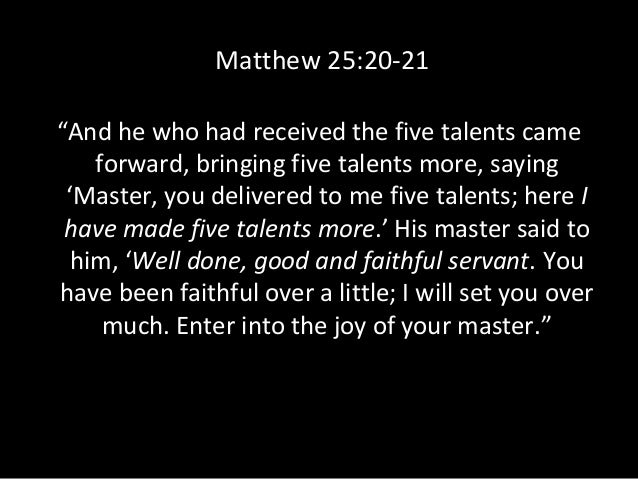
^Parable of the Talents^
Focus on making what you have better, not making the boss happy.
'Give your best people the best opportunities, and your best people are those who make the best out of the opportunities they've been given." (para-phrased Jim Collins).