You don't have to look far in the music industry to see that the millennial generation think that they can change the world, shine bright, and make a difference.
Rihanna - Diamonds
This is a positive thing, though. We were all created to be creators that would dream up the impossible and make it happen though God's awesome power.
I take the observation in this article, that the millennial generation are hugely optimistic and look for value in a job in different areas to money, as a great encouragement. They're one step closer to their Creator. We are a generation that gets everything immediately: instant messaging, online shopping, 'likes' as instant feedback on photographs and videos that we share.
This means we know how to 'dream something up' and see it happen straight away. I went to a talk recently with Roy Crowne as the main speaker. He said that when we get dreams and visions from God we need to putting footing on them. In my experience, the longer you leave something without footing, the quicker it rolls away. So, a generation that has grown up with no bounds to the instant success that they can grasp has attempted their 'impossible' dreams and, in cases where God steps in, they have been realised.
Another positive to the mindset of the millennial generation is that failure isn't final. On social media failure lasts all of 3 days before it's been forgotten. This opens up the playing field for another try from another angle.
Something that could have been lost in the millennial generation upbringing is a strong sense of community. We're all the more cautious of people we see on the street. Are they to be trusted? But we've kept relationships going on social media that otherwise would have been lost. Just last week I met up with a group of friends, one of which I hadn't seen since the summer, to get a drink at the pub. We spoke about life and started straight where we left off from. These opportunities can play a key part in building that community element back up again.
We are not a lost generation; we're closer to finding our identities in God.
How can the millennial generation lead from a position of not being in charge?
"...in order to make anything better you have to think critically..."
Note the phrasing of this quote. The term 'think critically' is very different to the phrase 'being critical'. The latter brings a host of negative connotations.
Leaders within an organisation looking at how things can get better, and speaking about those, help the organisation to move forward. Those that keep it to themselves can fall into the trap of secretly wanting the organisation to fail: 'Well I knew it was bad from the start but they didn't do anything about it...'. This mentality is not ideal, or even helpful, for furthering any success.
Think like you're in charge, as if you're the owner.
When an owner sees rubbish on the floor, they pick it up. When an employee sees rubbish on the floor, they walk past and wait for someone else to do it. When you start making the steps to change what is wrong you project your feeling of: "This bothers me, I want this to bother everybody."
In summary to 'thinking critically' as an answer to the question,
Thinking critically = positive. Being critical = negative.
Danger = becoming cynical.
Image Source: Google
Jesus walked around with a towel not a clipboard.
Thinking critically is about finding out where you can help, not giving a score.
"Reject passivity... go make it better"
Passivity is allowing others to do things to you without complaining or pushing back (Google definition).
When we're not in charge we can begin to follow this trail of thought:
'When they get their stuff together, then I can get on with what I want to do, until then I'm going to have to wait.'
There has to be an organic origin to the way we make things better for furthering the success of the organisation. If we act out of spite and become negative about the things we are changing then we are being less helpful than if we were to stay passive. Spitefulness could lead to tension and stressful work relationships.
LIE: "When I'm in the leader's seat, then I'll have influence"
TRUTH: "Everyone has influence"
Passivity is not a good leadership strategy. If a babysitter was passive, the children would never go to bed, tie her to a chair and all she/he would respond with is 'please stop mis-behaving'.
"When there's something to blame, there's nothing to work on." The minute we shift the blame to someone or something else the problem is no longer our own. Just like with thinking critically we need to take ownership and not pass the baton.
"When I'm only waiting for someone to hand me something, I have the potential to become someone who won't be handed anything"
In other words, if we take ownership and start to show what we can do with what we've got then we will be handed more. But, the more that is on your plate, the less you will need to be handed because you've taken ownership and started making changes by working on the things in front of you.
Image Source: Google
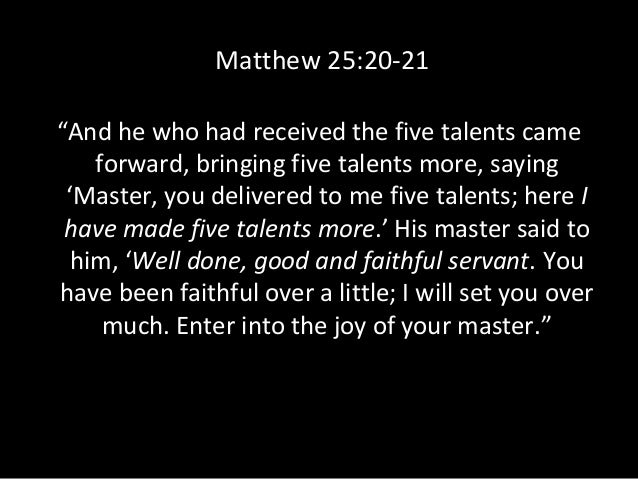
^Parable of the Talents^
Focus on making what you have better, not making the boss happy.
'Give your best people the best opportunities, and your best people are those who make the best out of the opportunities they've been given." (para-phrased Jim Collins).
For those of you that are searching or have searched in the past for the right uni, what is/was on your 'checklist'? You probably have a checklist of things which would make the perfect university for you. Perhaps accommodation with an en suite bathroom, or just accommodation which you can afford. Maybe the uni needs to be near a town centre. While I am searching for the right university for me, and praying about where I end up, I am also checking things off from a mental list:
1- Offer courses in the subjects that I am interested in (sort of essential)
2 - Sizeable room in accommodation for studying
3 - Have a Christian Union
4 - Job opportunities nearby
5 - Location
6 - Course content and vocational opportunities
7 - Close to home
That last thing on my list can be taken two ways. The first is as it first appears: no more than a couple of hours away from my childhood home. The second is a little deeper, and perhaps even more important, it is that I am close to God. He is my home, I will be with Him in Heaven for eternity and I would love to be with Him on earth, at university, and for the rest of my earthly existence.
Universities in the UK often have great Christian Unions available to their students, and nearby churches run amazing student programs but is this enough? For students who want to study Theology they can find a Christian College, such as Moorlands or Spurgeons, and settle in with other like-minded Christians. For those who wish to study music, art, maths, english, or science they have it a little more difficult. They will be in an environment everyday surrounded by young adults who want to live life and have fun, regardless of what God has planned. Young Christian's faith will be pushed to the limit at University, and without the support that nearby churches and Christian Unions offer they could lose their relationship with God by drifting far away and building a wall between Him and themselves.
I was talking to a friend about this recently and a thought came to mind about a university which offers a range of courses and subjects whilst being a Christian organisation full of Christian students. Unfortunately, to my knowledge, such institution does not exist in the UK. In the US there a number of universities/colleges which are set up primarily for Christians such as Wheaton College, US. The courses that it runs are so extensive which makes it open to almost every Christian out there searching for a university to attend which does their course subject.
Would a Christian University be the answer?
To some extent I think that a similar institution would go down really well in the UK. There are so many Christians today looking for a university to study at which won't harm their faith too much whilst challenging it just enough.
However, there are also stories of Atheists who met Christians at university and their lives were changed for the better. Would an exclusively Christian University damage the potential to spread God's love? Perhaps so. Or maybe not if the institution was to be linked with a secular college.
I can't see these ramblings reaching a conclusion for the time being. I am just mulling over some thoughts which have taken over my revision this morning.
I think my new 'checklist' will be:
1 - Offer courses that I believe God is leading me to
2 - Accommodation which will enable me to mix with other Christians and non-Christians day in, day out
3 - An established Christian Union
4 - Job opportunities and charity opportunities to 'give back to God'
5 - Location - near to a supporting church with established Christian student facilities
6 - Course content and vocational opportunities - a schedule which doesn't clash with church involvement
7 - Close to home - a place where I am free to believe in God and express that to my heart's content